
- EXPLORE FURTHER: Researchers Uncover How Popular Diet May Enhance Intimate Performance
It's a dietary fad promoted by celebrities ranging from top-tier Hollywood stars to Rishi Sunak .
Today, researchers suggest that intermittent fasting might be more beneficial for shedding pounds compared to tracking calories.
Individuals following the 4:3 fasting regimen—where caloric consumption is limited for three days out of the week—tend to lose more weight compared to those who reduce their calories every day, according to research findings.
Adults who were overweight and adhered to the intermittent regimen for twelve months shed an average of about seven kilograms.
In contrast, those who restricted their calories lost less than half of this amount of weight.
An American researcher involved in this study mentioned that the findings suggest frequently abstaining from food more than several days per week might be overly strict for successful weight reduction.
'We believe fasting three days each week could be just about perfect for weight loss As stated by Victoria Catenacci, the study’s co-senior author and an associate professor at the University of, Colorado Anschutz Medical Campus.
'Having more fast days each week might be overly strict and hard to maintain, whereas having less frequent fast days could fail to create a significant enough caloric shortfall to surpass daily calorie-restricted eating plans.'
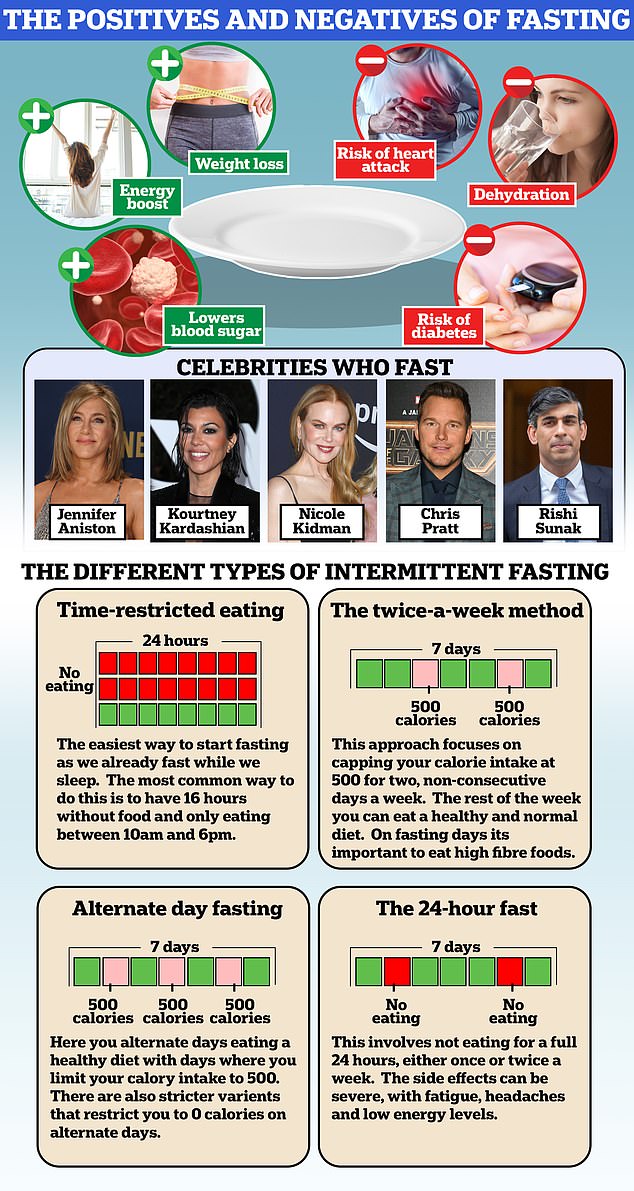
Even though numerous research papers indicate that intermittent fasting — which rose to fame in the early 2010s — has done work Experts continue to disagree about its efficacy and the possible long-term health effects.
Some people believe that those who fast often tend to eat a significant amount of food at once, which means they might not reduce their calorie intake—a common method for weight loss.
They even warn that it may increase the likelihood of strokes, heart attacks or early death.
In the new research, scientists looked at 165 individuals who were either overweight or obese and divided them into two dietary groups.
The individuals in the 4:3 group whofasted for three days a week were required to limittheir calorie intakeby 80 percentonthe fastingdays.
If their starting point was 2,500 calories per day, they would consume approximately 500 calories on those specific days.
The calories consumed over the next four days had no restrictions, but they were advised to opt for healthier eating options.
Meanwhile, the participants assigned to the reduced-calorie group were instructed to consume approximately 35 percent less food daily compared to their normal intake.

This implies that both teams were expected to function with the same energy deficit throughout each week.
The research team provided every participant with behavioral assistance, complimentary gym memberships, and urged them to work out for a minimum of 300 minutes weekly.
Publishing in the magazine The Journal Annals of Internal Medicine The researchers mentioned that participants engaging in the 4:3 fast experienced a loss of 7.6 percent of their body weight after one year.
This was at 5 percent for individuals who limited their daily caloric consumption.
Adam Collins, an associate professor of nutrition at the University of Surrey, stated: "The primary outcome of the research indicates that adopting a 4:3 strategy leads to greater weight loss compared to traditional calorie restriction methods, even though participants were assigned the same total caloric intake."
'This, however, is not an inherent advantage of the 4:3 method itself, but rather due to their larger caloric deficit.'
He mentioned: "Sticking to any diet for 6-12 months can be difficult under ideal conditions; however, this might clarify why the 4:3 group generally reached the calorie deficit objective more closely."
'However, this supports the idea that, in reality, sporadic energy restriction plans perform better than regular daily caloric restrictions when considering adherence and outcomes.'
It is widely recognized that obesity elevates the risk of severe health issues, including those that can harm the heart like hypertension, along with various types of cancer.
It is believed to be responsible for one out of every 20 cases. cancer According to Cancer Research UK, cases have been observed in Britain.
Britain's obesity crisis is also estimated to cost the nation nearly £100billion per year .
This massive number encompasses the health damages caused by it. NHS As well as indirect economic impacts such as missed wages because of sick leave and losses from premature fatalities.
Specialists attribute the country's increasing obesity to the parallel growth of unhealthy, high-calorie diets from processed foods and the more sedentary, office-centric living patterns.
Read more